


July at LBKP was dominated by employment law. There was no shortage of significant legislative changes, expert commentary, and practical analyses. The spotlight was also on AML-related topics, as well as NIS2 and the AI Act, which consistently remain among the most crucial areas for business.
In this issue, we have also gathered the most interesting materials from the past month – from expert analyses and event reports to selected publications as part of the TechnoLegals programme. We hope this bulletin will be a convenient way for you to quickly catch up on July’s most important topics.
Our bulletin summarises July, but since you are reading it in August on LinkedIn, we couldn’t skip the AI Act. Therefore, at the end, we are leaving a brief reminder of the most important rules regarding the publication of content using artificial intelligence.
The AI Act and LinkedIn – who needs to label AI-generated content?
Here is the translation of the newsletter into British English, with formatting added to enhance readability:
July at LBKP was dominated by employment law. There was no shortage of significant legislative changes, expert commentary, and practical analyses. The spotlight was also on AML-related topics, as well as NIS2 and the AI Act, which consistently remain among the most crucial areas for business.
In this issue, we have also gathered the most interesting materials from the past month – from expert analyses and event reports to selected publications as part of the TechnoLegals programme. We hope this bulletin will be a convenient way for you to quickly catch up on July’s most important topics.
Our bulletin summarises July, but since you are reading it in August on LinkedIn, we couldn’t skip the AI Act. Therefore, at the end, we are leaving a brief reminder of the most important rules regarding the publication of content using artificial intelligence.
The AI Act and LinkedIn – who needs to label AI-generated content?
Since 2 August, new AI Act regulations regarding transparency in the use of artificial intelligence have been in force. A lot of questions and misunderstandings have arisen around the new regulations, which is why we have prepared a practical guide showing what actually changes for companies, experts, and participants in employee advocacy programmes.
- It is the publisher who is responsible for labelling the content The obligation of transparency rests with the person or organisation publishing the material – not with LinkedIn or the AI tool you are using.
- Not every text written with the help of AI needs to be labelled If the text has been verified, edited, and consciously published by a specific person, in most cases, it will not require a label. It may be different in the case of content concerning matters of public interest.
- Particular attention should be paid to graphics and video Realistic images, video recordings, or audio materials generated by AI may be subject to the labelling obligation. In the case of clearly fictional illustrations, the regulations provide for exceptions.
- Employee advocacy is also a professional activity Publishing content as part of an ambassador programme – even on a private LinkedIn profile – can be considered a professional activity. It is the nature of the publication that matters, not the type of account.
- It is worth establishing clear rules for using AI The new regulations do not prohibit the use of artificial intelligence in communication. However, they “encourage” greater transparency, so companies operating on LinkedIn should develop consistent rules for using AI when creating content.
This is a topic that will be relevant not only for marketing departments but also for HR, communications, and anyone building an expert brand on social media.
Summer Academy of GDPR Leaders: Practical Aspects of Audits and Implementations
Grzegorz Lesniewski has joined the panel of experts of the Summer Academy of GDPR Leaders organised by the Personal Data Protection Office. During a lecture dedicated to the practical aspects of GDPR audits, he will share his experience gained while carrying out compliance implementations and projects in organisations.

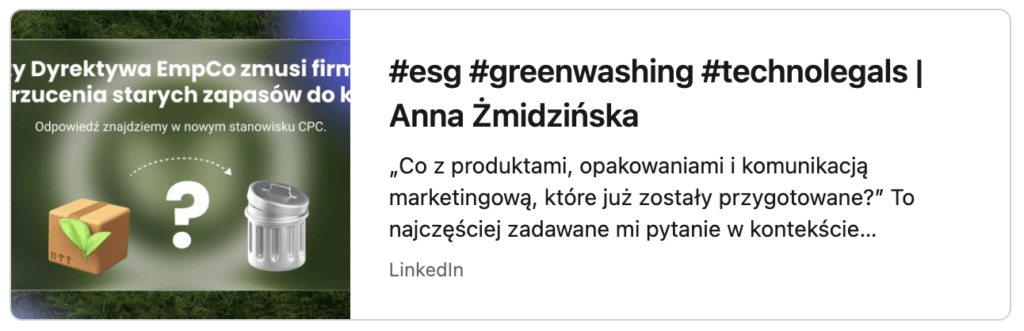
EmpCo: Will products prepared before 27 September 2026 need to be withdrawn from the market?
The Consumer Protection Cooperation (CPC) network has published a practical position regarding the so-called old stock situations, i.e., products, packaging, and marketing communication prepared before the EmpCo directive becomes applicable. The document indicates how authorities may approach the transitional period and the enforcement of new obligations.
Key takeaways for businesses:
- The mere fact of having stock does not exempt you from the obligation to adapt communication to the new requirements. The priority should be updating online content and gradually introducing changes to packaging and marketing materials.
- The authorities announce a pragmatic approach to the transitional period, taking into account, among other things, the scale of stocks and the realistic capabilities of businesses. However, it will be crucial to demonstrate that the organisation is actively preparing to ensure compliance with the regulations.
A well-negotiated settlement does not always mean the best financial outcome.
Dispute resolution strategy
The Supreme Court has confirmed that an out-of-court settlement does not always constitute a basis for the refund of the entire statement of claim fee. In practice, this means that when planning to end a dispute, not only the content of the agreement matters, but also the manner and timing of its conclusion.
What is worth paying attention to?
- The choice between an out-of-court settlement, a court settlement, or mediation can have a significant impact on the settlement of the proceedings’ costs.
- The dispute resolution strategy should take into account not only the business interests of the parties but also the procedural and financial consequences of the chosen solution.
Terminating Cooperation with an Employee
The date of posting the notice is not the date of its submission.
Delivering a termination notice by post or courier might seem like a simple solution, but in practice, the moment the statement is submitted depends on its effective delivery to the employee. It is this very stage that often becomes a source of costly mistakes and disputes.
What should you remember?
- A statement on the termination of an agreement produces legal effects only when the employee has had a real opportunity to familiarise themselves with its content – the mere posting of the parcel is not sufficient.
- Problems with delivery, leaving a missed delivery card (aviso), or a lost parcel can affect the effectiveness of the agreement’s termination, so it is worth considering more secure forms of delivery, including electronic solutions.

New Employer Obligations: Changes in Mobbing Regulations (November 2026)
The amendment will come into force 3 months after its publication (i.e. on 5.11.2026). From that moment, we have its new definition, and employers will bear the brunt of the changed obligations.
Including the most important one – the obligation to SYSTEMATICALLY counteract violations of the principle of equal treatment in employment. A longer deadline is envisaged for adjusting or introducing internal company regulations on counteracting undesirable behaviour – 6 months from the date the act comes into force (i.e. by 5.05.2027).
Why is it worth preparing now?
- The amendment changes not only the definitions but also increases the importance of preventive measures. Employers should review current procedures, training, and how they respond to reports.
- The changes should be analysed in conjunction with the new powers of the National Labour Inspectorate (PIP), as their practical application may significantly affect how risk is managed in the HR area.
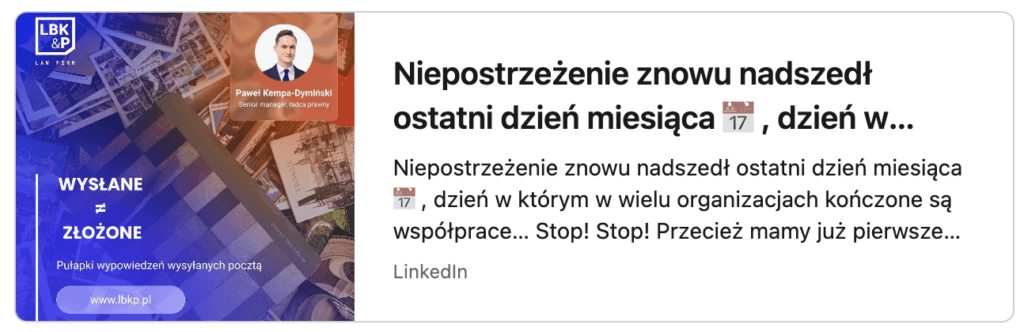
A “disciplinary termination” submitted by an employee? The employer cannot reject it.
The termination of an employment contract by an employee under Article 55 of the Labour Code takes effect upon the effective submission of the statement. This means that the employer cannot refuse to terminate the employment relationship, even if they consider the employee’s decision to be unjustified.
What can the employer do?
- Despite the obligation to issue an employment certificate, the employer may question the legitimacy of the contract’s termination, refuse to pay compensation, or – in specific cases – claim compensation from the employee for the unjustified termination of the employment relationship.
- However, the employer’s claims are limited. The regulations provide for the possibility of seeking compensation, but do not provide grounds to demand the employee’s reinstatement to work.

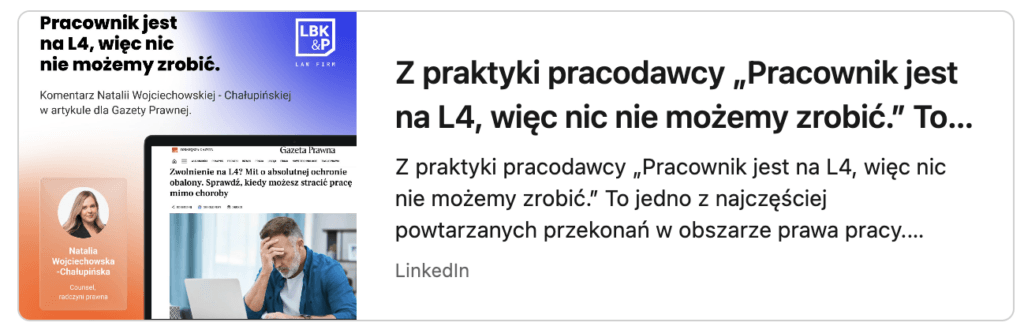
“The employee is on sick leave (L4), so there is nothing we can do.”
This is one of the most frequently repeated myths in employment law. Natalia Wojciechowska-Chałupińska, in a commentary for Gazeta Prawna, explains when the protection of an employee on sick leave is not absolute and what exceptions the regulations provide for.
What does this mean for employers?
- Sick leave does not preclude the termination of an agreement in every situation – the regulations provide for exceptions, e.g. in the event of long-term incapacity for work or a severe breach of employee duties.
- Every decision requires an individual assessment of the factual state and the correct application of the regulations, as mistakes at this stage often lead to court disputes.
Reclassification of B2B Contracts: What to pay attention to during an audit?
During an inspection, it is not only the content of the contract that matters, but above all, the way it is performed.
An audit of B2B contracts should not be limited to analysing contractual provisions. Controlling bodies also verify the practice of cooperation – procedures, rules applicable in the organisation, and the actual way duties are performed. It is on this basis that they assess whether the relationship is indeed of a B2B nature.
What is worth paying attention to?
- An effective audit covers not only contracts but also processes, internal documentation, and the daily practice of cooperation. These often determine the risk of reclassifying the contract into an employment relationship.
Free webinars concerning audits of B2B contracts and the practical aspects of preparing an organisation for an inspection are also available on the LBKP website.
DORA: new EBA guidelines for the financial sector. The EBA expands its approach to supplier risk management.
Financial institutions that have completed the implementation of DORA should not treat it as a closed project. The European Banking Authority (EBA) has just launched consultations on new guidelines concerning the management of risks related to external suppliers. This is another step showing the direction in which supervision will develop.
The most important conclusion? Supplier risk management is ceasing to be the exclusive domain of IT and cybersecurity departments.
The new guidelines indicate that financial institutions should pay even more attention to:
- the entire lifecycle of cooperation with a supplier – from selection and risk assessment, through ongoing monitoring, to the termination of cooperation,
- managing concentration risk, i.e., identifying situations where too many critical services rely on a single supplier or the same group of suppliers,
- governance and business responsibility – supplier risk management is to be a process involving not only IT, but also compliance, risk management, procurement, and the management board.
Although the guidelines are still at the consultation stage, they already show the direction of European regulators’ expectations. For banks and other financial institutions, this means it is worth taking another look at the supplier management model, the division of responsibilities, and the processes for monitoring services provided by external entities.
DORA is increasingly clearly demonstrating that digital operational resilience does not end with the security of IT systems. It encompasses the entire ecosystem of suppliers upon whom the continuity of the organisation’s operations depends.
AML is no longer the domain of banks. It is increasingly becoming the responsibility of management boards.
AML (Anti-Money Laundering) – New EU regulations and the expansion of the list of obliged institutions mean that AML is covering further sectors of the economy. At the same time, expectations towards organisations regarding effective risk management and supervision of the compliance system are growing.
Why is this important? AML is becoming an element of corporate governance. The obligations of management boards and their responsibility for ensuring an effective anti-money laundering system are of growing importance.
Merely having procedures is not enough. Organisations should regularly update their risk assessments, adapt their AML system to their operations, and demonstrate that the solutions applied work in practice.
NIS2: the first deadlines are already running. Does your organisation know that it is covered by the new obligations?
The new regulations cover a much broader catalogue of organisations than previous cybersecurity regulations. The sectors covered by the act include, among others, energy, transport, banking and financial market infrastructure, healthcare, digital infrastructure, telecommunications, ICT service management, postal services, waste management, chemicals and food production, as well as selected types of manufacturing and digital services.
In practice, this means that the regulations may apply to, among others, banks, hospitals, energy companies, cloud service providers, data centres, managed service providers (MSPs), managed security service providers (MSSPs), telecommunications undertakings, trust service providers, marketplace platforms, internet search engines, postal and courier companies, electronics and medical device manufacturers, or companies from the chemical, food, and waste management sectors.
Podmiot kluczowy czy ważny?
An essential or important entity? ⚠️ The industry itself does not yet determine the organisation’s status.
When determining whether a given organisation is an essential entity, an important entity, or is not subject to the act at all, one must primarily analyse:
- the actual scope of operations and services provided,
- the sector and type of entity indicated in Annex 1 or 2 to the act,
- the size of the enterprise, taking into account partner and linked enterprises,
- specific rules arising from Article 5 of the act.
In simplified terms: entities operating in the sectors indicated in Annex 1 can be essential or important entities depending on, among other things, their size. Entities from Annex 2 meeting the appropriate size criteria are generally important entities. However, the act provides for exceptions and special rules for, among others, electronic communications undertakings, DNS service providers, trust service providers, or managed security service providers.
Therefore, a cloud provider, data centre, or company providing IT services does not automatically become an essential or important entity solely due to the type of its operations.
This is important because the new regulations are not based on an individual notification from the authority. It is the entrepreneur themselves who should analyse their operations and assess whether they meet the criteria for being deemed an essential or important entity. If so, specific obligations and deadlines arise. One of the closest is 3 October 2026, by which many entities will have to register in the KSC (National Cybersecurity System) Register. Another significant deadline is 3 April 2027, when the period for implementing the obligations arising from the act and starting to use the S46 system expires.
In practice, however, preparation for NIS2 does not come down to registration. Organisations should verify, among other things, the way cybersecurity risk is managed, incident reporting procedures, business continuity plans, supply chain security, and the division of responsibilities between the management board, IT, compliance, and business. It is these areas that will be of crucial importance when assessing compliance with the new requirements.
If your organisation has not yet checked whether it falls within the scope of NIS2, it is worth doing so as soon as possible. In many cases, the greatest risk will not be the lack of a single procedure, but starting the entire adaptation process too late.
Coldplay in Fortnite. When music becomes a gameplay element
On the occasion of the premiere of the Moon Music album, the band Coldplay appeared in the playable iHeartLand experience in Fortnite. This is an interesting example showing that the use of music in games increasingly goes beyond the classic soundtrack and becomes an integral element of gameplay mechanics. From a legal perspective, this means much more complex issues related to the licensing of copyright.
Why is this important?
- When using music in games, it is necessary to properly secure the rights to the compositions, recordings, and artistic performances, as well as define the rules for using the works in trailers, live broadcasts, or materials published on social media.
- The more tightly music is integrated with the game mechanics – e.g. triggered by the player’s actions, looped, or constituting a gameplay element – the more important it becomes to precisely define the scope of the licence and ensure compliance with the requirements of distribution platforms.

A publishing agreement is not a formality. It is one of the most important stages of a game’s commercialisation.
For many game development studios, negotiations with a publisher are their first experience of this kind. Meanwhile, publishers conclude similar agreements regularly and know perfectly well which provisions are of the greatest importance for the project’s future. As a result, it is during the negotiation stage that decisions are often made that affect how the game is commercialised and the scope of rights remaining with the studio.
Why is this important?
- Well-prepared negotiations allow for a conscious determination of the rules regarding intellectual property rights, revenue sharing, the parties’ obligations, or the possibilities for further project development. It is these provisions that often have a greater impact on the studio’s future success than the mere signing of the agreement.
- In practice, it is worth remembering that experience in game development does not always go hand in hand with experience in negotiating publishing contracts. Proper preparation for talks allows the studio’s interests to be better protected and avoids the consequences resulting from unknowingly accepted clauses.

Does “buying a game” mean owning it?
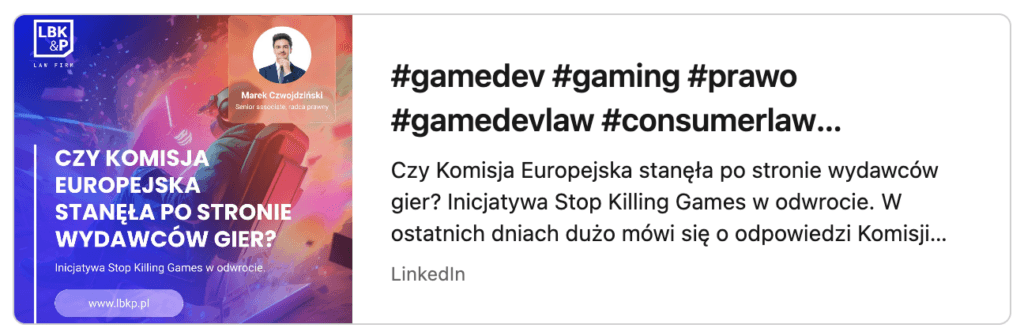
The Stop Killing Games initiative has sparked a broad discussion about players’ rights and publishers’ obligations after ending support for games. Although the European Commission’s response does not mean imposing an obligation on publishers to maintain online infrastructure for an unlimited time, the debate has once again drawn attention to the issue of transparency towards consumers using digital products.
A question worth asking yourself: Players should know already at the purchase stage whether they are buying a game or merely a licence to use it, how long the product will be supported, and what will happen to it after the servers are shut down. Clear rules regarding the access model and the publisher’s obligations can reduce the risk of misunderstandings and increase trust in the market.
The discussion around the Stop Killing Games initiative will probably not end with the European Commission’s response. The planned Digital Fairness Act may become the next step towards strengthening information obligations towards consumers and setting new standards for the digital games industry.
LBKP’s Plans for August: HR, Employment Law, and Webinars
August promises to be equally intense. In the coming weeks, we will be sharing further materials for entrepreneurs, HR departments, and the new technologies industry, as well as working on new initiatives that will respond even better to your needs.
It is worth following our profiles if you are interested in:
→ further analyses and commentary on employment law, AI, cybersecurity, AML, and GameDev,
→ new publications dedicated to legislative changes and their practical impact on business,
→ a new bulletin dedicated to HR specialists and employers, in which we will focus on the practical aspects of employment law, team management, and the most important challenges facing HR departments,
→ the return of our webinars as early as September – we are preparing further online meetings dedicated to the most current issues in the areas of law, tax, and business.
Thank you for reading the July issue of LBKP Inside. See you in the next edition!
