


The first half of the year is behind us, bringing with it further publications, webinars, and expert commentary on the most important changes in law, technology, and business.
In LBKP Inside, we have brought together the most interesting materials published in June – from expert analyses and events to selected publications from the #TechnoLegals programme. We hope this newsletter serves as a convenient way for you to quickly catch up on the month’s key topics.
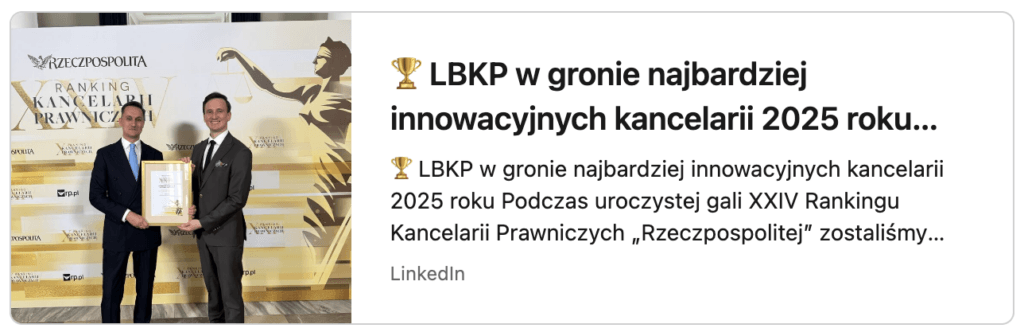
🏆 LBKP Among the Most Innovative Law Firms
This was an exceptional month for us.
During the gala of the 24th Rzeczpospolita Law Firm Ranking, we were awarded distinction in the “Most Innovative Law Firms of 2025” category.
This distinction is particularly valuable as it was awarded not for a single tool or technology, but for the way we collaborate with clients – based on Embedded Legal, Business First Policy, and Legal Solutions Not Hours.
Additionally, we once again ranked in the TOP 10 largest law firms in Lower Silesia.
On the Regulatory Radar
AI Act with Important Changes: EU Council Approves Simplification of Rules (Omnibus VII)
At the end of June, the Council of the European Union gave its final approval to a package of amendments simplifying the application of the AI Act. This is one of the most important regulatory decisions concerning artificial intelligence since the adoption of the regulation.
The new rules aim to reduce administrative burdens on businesses, clarify obligations related to high-risk AI systems, and better coordinate the AI Act with sector-specific regulations.
In brief:
- Postponed deadlines: Obligations concerning high-risk AI systems have been pushed back – for some systems, they will apply from 2 December 2027, and for systems embedded in products, from 2 August 2028.
- Bans: From December 2026, using AI to create non-consensual sexual deepfakes and child sexual abuse material will be strictly prohibited.
- Guidance: The European Commission will prepare additional guidance to help businesses implement AI Act requirements and reduce administrative burdens.
This is a topic we will be monitoring closely in the coming months, as the changes are of significant importance for organisations developing or utilizing AI systems.
Expert Appearances & Events
Marek Czwojdziński spoke at the Game Industry Conference, where he discussed the legal risks associated with using assets in video games and how studios can effectively protect their projects as early as the production stage.
Two key aspects to keep in mind:
- Not every “free” asset can be used without restrictions – before using one, it is advisable to verify licence terms and rights for further use.
- Proper intellectual property management at the production stage helps mitigate the risk of disputes and costly problems after the game’s release. ➡️ View the event coverage.

Meanwhile, Paweł Kempa-Dymiński took part in the Re:Mind 2026 conference, joining a panel dedicated to lawyers’ well-being to discuss the impact of organisational culture, AI, and generational shifts on the modern job market.
Key takeaways for organisations:
- Employee well-being is increasingly becoming a core element of organisational strategy – affecting not only team satisfaction, but also work quality, reduced staff turnover, and business growth.
- Newer generations define professional success differently, making the creation of a healthy work environment one of the key challenges for modern employers.

Cardboard Doesn’t Always Mean Eco
“Eco” Is Not Enough: How to Protect Your Company from Greenwashing Allegations?
Anna Żmidzińska and Andrzej Miziołek showed how to prepare an organisation for changes resulting from the EmpCo Directive, PPWR, and EPR (ROP), and how to reduce the risk of greenwashing when designing packaging.
What does this mean for businesses?
- Environmental claims must be specific, documentable, and backed by evidence – general terms like “eco” or “environmentally friendly” may soon no longer suffice.
- Safe packaging optimisation requires collaboration not just within marketing, but also across legal, ESG, procurement, and product development departments.

Estonian CIT Debunked
Katarzyna Kot explained when Estonian CIT (corporate income tax) can truly be a beneficial solution, and when the classic taxation model remains the safer choice. The webinar served as a practical guide for entrepreneurs planning a change in their taxation model.
Key takeaways from the webinar:
- Estonian CIT is not a one-size-fits-all solution – the decision to change tax models should be preceded by an analysis of the company’s operational profile and business goals.
- Prior to implementation, it is essential to verify entry conditions and potential risks associated with hidden profits and non-business expenses.
- When structured properly, Estonian CIT offers numerous opportunities.

Must-Read Publications
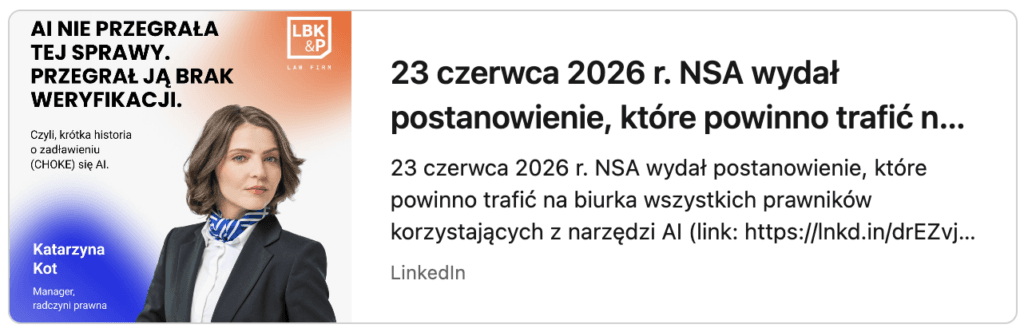
AI Does Not Relieve You of Responsibility
Katarzyna Kot commented on the widely discussed Supreme Administrative Court (NSA) ruling regarding the use of artificial intelligence in drafting court pleadings. This is an important voice in the debate on the responsible use of AI in professions of public trust.
What does this mean in practice?
- AI can support a lawyer’s work, but it does not assume responsibility for verifying sources, the correctness of legal arguments, or the quality of the service provided.
- Professionalism in the era of AI lies not in abandoning new technologies, but in using them consciously and responsibly.
Cross-Border Disputes – Before Filing a Lawsuit
Is a judgment alone enough to recover debts from a foreign contractor? In our June publication, we explain why, in cross-border disputes, planning effective enforcement in advance and analysing procedures in other jurisdictions is just as critical as drafting the lawsuit itself.
In brief:
- Obtaining a judgment alone does not guarantee debt recovery – planning effective enforcement abroad in advance is equally important.
- The earlier procedural and international issues are analysed, the greater the chances of actual debt recovery.
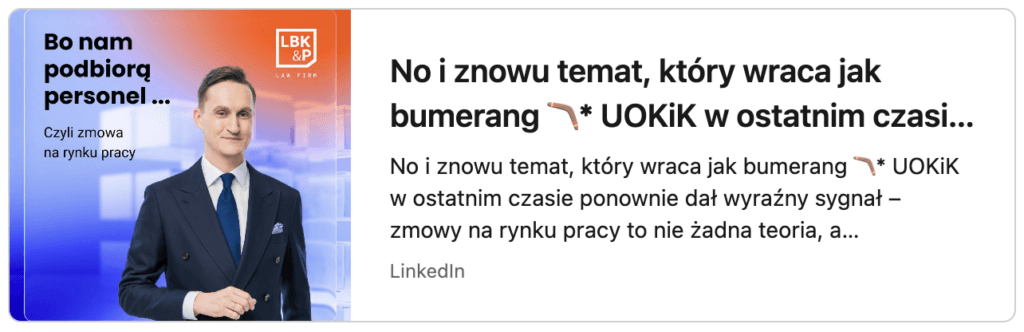
Labour Market Collusion Under the UOKiK Spotlight
Can non-poaching clauses violate competition law? This topic is increasingly emerging in day-to-day business practice.
In brief:
- Non-poach / non-solicitation clauses, which were standard contract terms just a few years ago, may now carry significant legal risks and attract scrutiny from UOKiK (Office of Competition and Consumer Protection).
- Protecting company interests today requires solutions that are not only effective but also legally compliant – it is worth periodically reviewing standard agreements and clauses.
What Lies Ahead?
July promises to be just as intensive.
In the coming weeks, we will be sharing further materials for entrepreneurs and HR departments, as well as continuing our expert series.
Follow our profiles if you are interested in:
- ➔ A new series by Paweł Kempa-Dymiński dedicated to practical aspects of employment law and the termination of employment relationships,
- ➔ Upcoming tax webinars hosted by Katarzyna Kot,
- ➔ Further events and publications on ESG, EmpCo, PPWR, and EPR (ROP) with Anna Żmidzińska,
- ➔ Expert commentary on AI and new technologies in business – check out Jacek Cieśliński, Mateusz Borkiewicz, Grzegorz Leśniewski, and Ewa Knapińska for the latest insights on AI, e-commerce, and GDPR (RODO),
- ➔ Speaking engagements by our experts at industry conferences.
See you in the next edition of LBKP Inside!
